A practical business guide by Arun Agrawal
Chosen Worldwide
How Indian exporters get discovered online, earn the overseas buyer’s trust and win the enquiry
Your export orders come through fairs, agents, buying houses and buyers who have known you for years. But a sourcing manager in Hamburg or Ohio cannot drive to your factory, so she opens your website first, often while your office is asleep.
What does she find?
- 90-page book
- Free PDF
- No registration

- Technology entrepreneur since 1986
- Founder & CEO, EbizIndia
- M.E., Jadavpur University (Gold Medal)
- TiE Charter Member
- Speaker at NASSCOM, TiE, CII, Indian Chamber of Commerce, ICAI and IIT Kharagpur events
Written for Indian companies that make goods and sell them to businesses abroad
Chosen Worldwide is built around the five questions an overseas buyer is settling: are you real, do you make what I need, can you deliver my order on time, will you keep me out of trouble, and who has trusted you already. Twelve short chapters cover proof that the company is real, product pages with packing and HS codes, capacity and lead times, audits and certificates, buyers and fairs, buyers who find you through Google or an AI assistant, and the route from a visit to an enquiry.
Your orders come through fairs, agents, buying houses and buyers who have known you for years, and the guide says so. Nothing in it promises a ranking or an order. Every check can be done on your own phone, and the brief at the back is written for your own web team.
Particularly useful for
- Jute, cotton and canvas bag makers
- Home textile and made-ups exporters
- Carpet and rug makers
- Brass, iron and aluminium home decor makers
- Wooden handicraft and furniture exporters
- Leather goods makers
- Foundries, forge shops and machined-parts makers selling to Europe, the Gulf and the US
- Merchant exporters working with a set of partner units
The idea at the heart of the guide
The Overseas Buyer’s Five Questions
A sourcing manager in Hamburg, a compliance officer at a retail chain, a buying agent’s merchandiser in Delhi and a quality engineer in Italy are settling the same five things. Are you real? Do you make what I need? Can you deliver my order, to my standard, on time? Will you keep me out of trouble? Who has trusted you already?
Most exporters can answer all five well. The answers sit in the GST registration, the audit reports, the shipping files and the owner’s head. The guide shows how to write them on the website: the legal name and the factory on the map, sizes and carton packing, capacity in the buyer’s unit, each audit with its reference, and buyers named with their consent or described by country and type.
- 1 of 30
- websites gave a certificate number, on the pages read
- 0 of 30
- gave carton or container packing for a product
- 5 of 30
- named at least three buyers, or described them by country and type
A check of 30 websites of mid-sized Indian exporters, six in each of five groups of trades, run for this guide on 8 October 2026. The home page and up to four inner pages per site were read, as text. A fact not found on those pages may be elsewhere on the site. Method and limits are at the back of the guide.
Don't just read it. Use it.
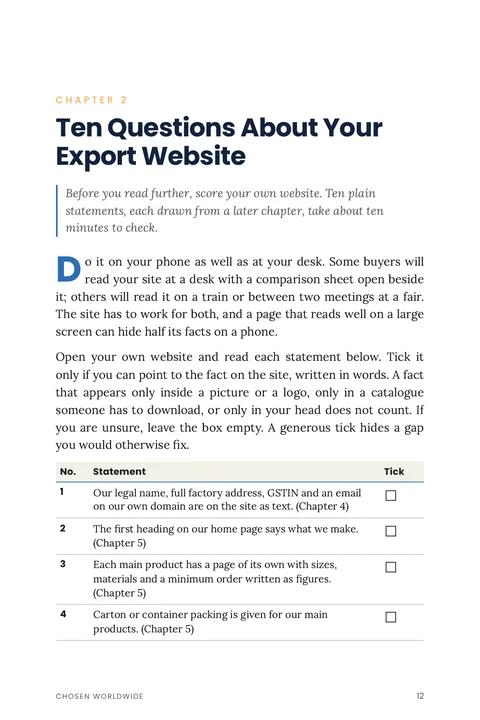
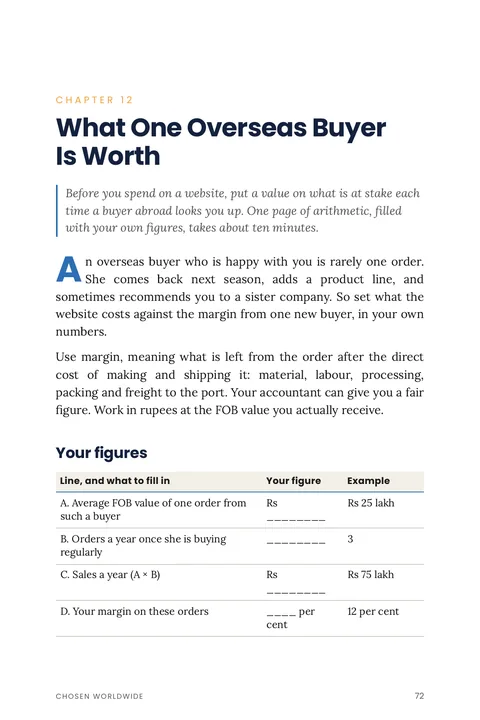
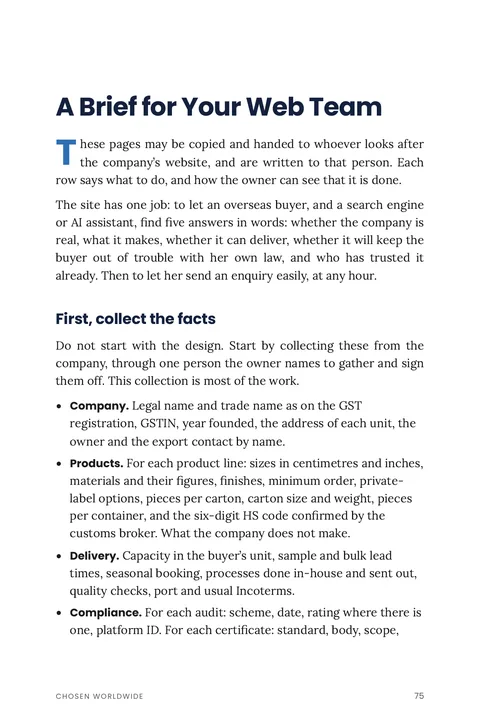
The guide is built to be worked through. It comes with the checks, plans and sheets a business owner can use without outside help.
What's inside
- Why I Wrote This Book
- About the Author
- Before You Start
- 1The Buyer Who Cannot Visit
- 2Ten Questions About Your Export Website
- 3The Overseas Buyer’s Five Questions
- 4Prove You Are Real
- 5Say What You Make
- 6Prove You Can Deliver
- 7Keep the Buyer Out of Trouble
- 8Prove Your Record
- 9Buyers Who Do Not Know You Yet
- 10From Visit to Enquiry
- 11A Worked Example: The Rug Maker
- 12What One Overseas Buyer Is Worth
At the back
- A Brief for Your Web Team
- About the 30-Site Check
- Work With EbizIndia
Inside the guide
- What a buyer abroad looks for in the ten minutes before she writes
- Proof that the company is real: legal name, GSTIN, the factory on the map, people with names
- Product pages with sizes in centimetres and inches, the minimum order, carton packing and the HS code
- Capacity in the buyer’s unit, lead times from approved sample to port, and her booking season
- Social audits and certificates, written the way a compliance officer checks them
- Countries, buyers and fairs, named with consent or described by country and type
- The words buyers abroad type, and how ChatGPT and Gemini find makers
- A “How we work” page, and an enquiry route that works while your office is closed
About Arun Agrawal
In 2007 he founded EbizIndia Consulting Pvt. Ltd., which transforms websites and builds custom software for companies in India, the UK and the USA, and runs its own SaaS products, WedPlan and CTRACKER. He holds a Master of Engineering from Jadavpur University, where he was awarded the Gold Medal, is a Charter Member of TiE, and has spoken at events hosted by NASSCOM, TiE, CII, the Indian Chamber of Commerce, the ICAI, MCCI, the Direct Taxes Professionals’ Association and the Entrepreneurship Cell of IIT Kharagpur.
His work today centres on website transformation: rebuilding business websites so Google and AI assistants find, understand and recommend them, and visitors turn into enquiries. He also leads EbizIndia’s custom business software, SaaS and workflow automation work.
His guides set out the frameworks he uses in that work, in plain language for business owners.
Kept up to date
The guide is revised as Google and the AI assistants change how they choose which businesses to name. The PDF always stays at the same address, so the copy you download, or a link you share, is always the latest edition.
-
First edition
- The first edition. Rules, standards and platform features checked on 8 October 2026.
| Title | Chosen Worldwide: How Indian exporters get discovered online, earn the overseas buyer’s trust and win the enquiry |
|---|---|
| Author | Arun Agrawal |
| Publisher | EbizIndia Consulting Pvt. Ltd. |
| Edition | First edition, October 2026 |
| First published | 21 October 2026 |
| Pages | 90 |
| Format | Book (PDF, free) |
| Language | English |
Questions about the guide
Is the guide free?
Yes. The full guide is a free PDF on this page, with no form to fill in and no registration.
Which exporters is it written for?
Owners and directors of Indian companies that make goods and sell them to businesses abroad: importers, brands, retail chains, distributors and manufacturers. The examples include bags and home textiles, carpets and rugs, brass and iron decor, wooden handicrafts and furniture, leather goods, and castings, forgings and machined parts. It also suits a merchant exporter working with partner units.
Does it cover food, pharmaceuticals or selling on Amazon and Etsy?
No. Food and agricultural goods, pharmaceuticals and chemicals have rules that would need a book of their own, and the guide does not cover selling to shoppers through Amazon, Etsy and the like.
My orders come through fairs, agents and buying houses. Why would a website matter?
Those routes will keep bringing your orders, and the guide says so. What has changed is the step before the first email. A buyer who picks up your name at a fair or from an agent now looks you up before she writes, and so does her compliance officer. She cannot visit your factory first, so the website stands in for the visit.
What are the overseas buyer’s five questions?
Are you real? Do you make what I need? Can you deliver my order, to my standard, on time? Will you keep me out of trouble? Who has trusted you already? Chapter 3 sets them out, and Chapters 4 to 8 take them one at a time.
Does it tell me which certificates or audits my goods need?
No. That is between you, your buyer and your testing laboratory. The guide shows how to write the audits and certificates you already hold so that a buyer and her compliance officer can check them. It does not advise on pricing, shipping or getting paid either.
Do I need technical knowledge to use it?
No. It is written for owners and directors, and every check can be done on your own phone. Chapters 1 to 10 each end with three things you can do that week without a web team, and A Brief for Your Web Team at the back turns the website work into a list your web team can work through.
Does it promise that Google or ChatGPT will recommend my company?
No. Nobody can promise that. The guide does not promise a ranking, a place in an AI answer or an order. It shows which facts a buyer abroad looks for, and how to write them where she, a search engine and an AI assistant can read them.
What is the 30-site check?
For this guide the websites of 30 mid-sized Indian exporters, six in each of five groups of trades, were read on 8 October 2026: the home page and up to four inner pages per site, as text. The results and the limits of the method are at the back of the guide. The sites are not named.
Are the buyers in the guide real people?
No. The short scenes showing a buyer at work are imagined and are not reports of interviews, and the rug maker in Chapter 11 is a worked example, not a real company. The guide says so on its copyright page.
I sell within India. Is this the right guide?
If your buyers are purchase managers, contractors and projects in India, Before the Buyer Calls at ebizindia.com/books/industrial-manufacturer-website/ is written for you. If you sell through dealers, Grow Through Dealers at ebizindia.com/books/dealer-network-website/ is.
Want to know where your own business stands?
You can run every check in the guide yourself, with the sheets above.
If you would rather have an outside view of your website and online presence, EbizIndia prepares an AI Search Visibility Blueprint: a detailed report on where your business stands with Google and the AI assistants, where it is being left out, and what to fix first.