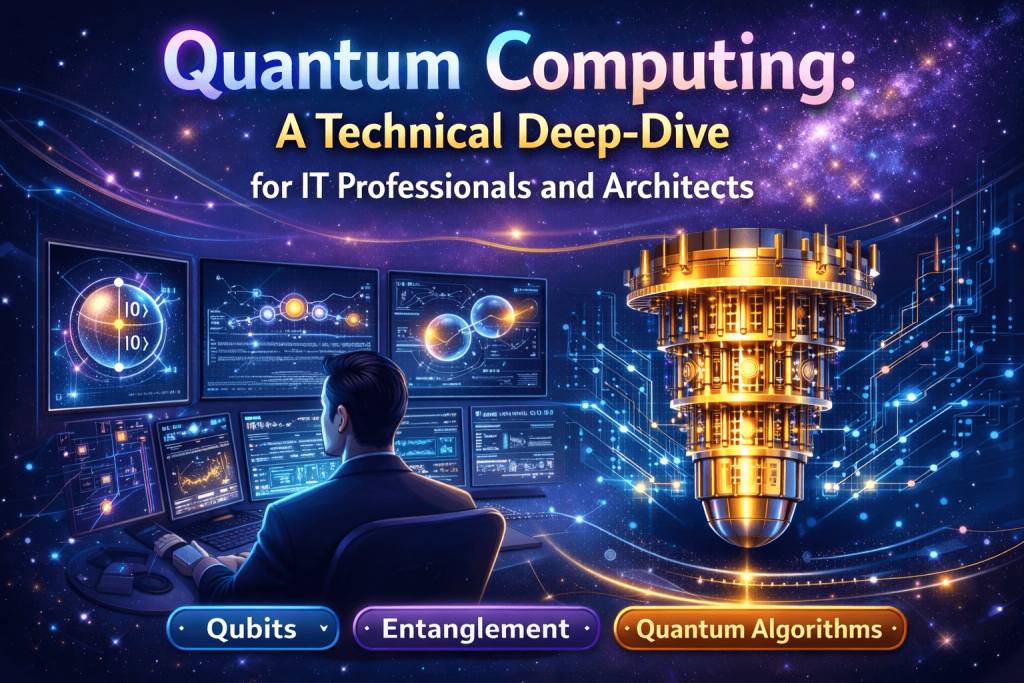
Quantum Computing: A Technical Deep-Dive for IT Professionals and Architects
If you’ve grasped the basics of quantum computing from our introductory guide to quantum computing, you’re ready for a deeper technical understanding. This post explores the engineering principles, cryptographic implications, and architectural considerations that IT professionals, system architects, and tech leaders need to understand.
We’ll skip the hype and focus on what actually matters for technical decision-making.
As we enter 2026, quantum computing has transitioned from pure research to early commercial deployment, making this the critical year for enterprises to begin their post-quantum cryptography migration.
Understanding Qubits: Beyond the Marketing
Classical bits are binary—0 or 1, on or off. This isn’t just a design choice; it’s fundamental to how transistors work.
Quantum bits operate differently. They leverage quantum mechanical properties that don’t exist in classical physics.
Superposition: Parallel State Processing
A qubit exists in a probabilistic combination of states until measured. Mathematically, this is represented as a linear combination of basis states with complex probability amplitudes.
Why this matters technically:
With n qubits in superposition, you can represent 2ⁿ states simultaneously:
- 10 qubits = 1,024 states
- 50 qubits = 1.125 quadrillion states
- 300 qubits = more states than atoms in the observable universe
But here’s the engineering catch: measurement collapses this superposition. You only extract one result. Quantum algorithms must be designed to amplify correct answers through interference patterns while cancelling out incorrect ones.
Entanglement: Correlated Quantum States
When qubits become entangled, measuring one instantaneously determines the state of others, regardless of physical distance. This isn’t classical correlation—the states are fundamentally linked at the quantum level.
Engineering implications:
- Enables certain computational shortcuts that are impossible classically
- Creates quantum networks for distributed computing
- Forms the basis of quantum cryptographic protocols
- Requires careful state management to maintain
Decoherence: The Engineering Challenge
Qubits are extraordinarily fragile. Environmental noise like thermal vibrations, electromagnetic interference, cosmic rays, destroys quantum states within microseconds to milliseconds.
Current coherence times by technology:
| Technology | Coherence Time | Companies | Maturity |
|---|---|---|---|
| Superconducting circuits | 100-500 μs | IBM, Google, Rigetti | Production |
| Trapped ions | Seconds to minutes | IonQ, Honeywell, Quantinuum | Production |
| Photonic qubits | Nanoseconds (propagation) | Xanadu, PsiQuantum | Development |
| Neutral atoms | Seconds | QuEra, Atom Computing | Development |
| Topological qubits | Theoretically indefinite | Microsoft (research) | Theoretical |
Infrastructure requirements:
- Dilution refrigerators maintaining 15 millikelvin (99.998% of absolute zero)
- Electromagnetic shielding comparable to SCIF facilities
- Ultra-high vacuum chambers
- Vibration isolation systems
- Specialized cryogenic electronics
This is why quantum computers aren’t replacing your data centre anytime soon.
Quantum Gates: The Instruction Set
Classical computers use logic gates (AND, OR, NOT) operating on definite bit values. Quantum computers use unitary transformations that manipulate probability amplitudes.
Single-Qubit Operations
Pauli Gates (X, Y, Z):
- X-gate: Bit flip (analogous to classical NOT)
- Y-gate: Combined bit and phase flip
- Z-gate: Phase flip (no classical equivalent)
Hadamard Gate:
Creates equal superposition from a definite state. This is the fundamental operation that generates quantum parallelism.
Phase Gates (S, T):
Adjust the phase relationship between quantum states. Critical for interference-based algorithms.
Two-Qubit Operations
CNOT (Controlled-NOT):
The quantum equivalent of conditional logic. Flips a target qubit only if the control qubit is in a specific state. Essential for creating entanglement.
SWAP:
Exchanges quantum states between qubits. Required because not all qubits can interact directly in physical implementations.
Gate Fidelity: The Performance Metric
Gate fidelity measures how accurately a quantum gate performs its intended operation.
Current state-of-the-art:
- Single-qubit gates: 99.9%+ (trapped ions), 99.5%+ (superconducting)
- Two-qubit gates: 99%+ (trapped ions), 98%+ (superconducting)
Why this matters:
A 1000-gate algorithm with 99.9% gate fidelity has only 37% success probability. This is why error correction is non-negotiable for useful quantum computing.
Quantum Algorithms: Computational Complexity Analysis
Shor’s Algorithm: The Cryptographic Threat
Function: Factors large integers in polynomial time
Complexity: O((log N)²(log log N)(log log log N)) versus classical O(exp((log N)^1/3 (log log N)^2/3))
Practical implications:
- RSA-2048 factorization: ~4,000 logical qubits required
- Timeline: 2030-2035 with current progress
- Current achievement: Factored 21 (3×7) using specialized quantum circuits
The mechanism:
- Reduces factorization to a period-finding problem
- Uses quantum Fourier transform to identify periodicity
- Classical post-processing extracts factors
System requirements for breaking RSA-2048:
- 4,000-20,000 logical qubits (depending on implementation)
- Millions of physical qubits with error correction
- Hours of coherent computation time
- Error rates below 10⁻¹⁵ per gate
Grover’s Algorithm: Symmetric Cryptography Impact
Function: Unstructured database search
Complexity: O(√N) versus classical O(N)
Cryptographic impact:
| Algorithm | Classical Security | Quantum Security | Mitigation |
|---|---|---|---|
| AES-128 | 128-bit | 64-bit | Use AES-256 |
| AES-192 | 192-bit | 96-bit | Use AES-256 |
| AES-256 | 256-bit | 128-bit | Still secure |
| SHA-256 | 256-bit | ~128-bit | Still acceptable |
| SHA-512 | 512-bit | 256-bit | Strong margin |
Key takeaway: Double your symmetric key lengths. AES-256 and SHA-512 remain quantum-resistant.
Quantum Simulation: Chemistry and Materials
Purpose: Simulate quantum systems that are exponentially hard for classical computers
Current capabilities:
- Small molecules: H₂, LiH, BeH₂ (6-12 qubits)
- Ground state energy calculations
- Basic chemical reaction pathways
Projected capabilities (2028-2032):
- Drug candidates: 50-100 qubits
- Catalyst design: 100-200 qubits
- Complex materials: 200+ qubits
Algorithmic approaches:
- Variational Quantum Eigensolver (VQE): Hybrid quantum-classical
- Quantum Phase Estimation (QPE): Fully quantum but requires more qubits
- Quantum Approximate Optimization Algorithm (QAOA): For combinatorial problems
The NISQ Era: Current Capabilities and Limitations
NISQ stands for Noisy Intermediate-Scale Quantum—where we are today.
Defining Characteristics
Scale: 50-1,000 physical qubits
Noise: Error rates of 10⁻³ to 10⁻⁴ per gate
Coherence: Limited to shallow circuits (<100-1000 gates)
Error Correction: Partial or none
What’s Actually Possible Now
Demonstrable quantum advantage:
- Specific sampling problems (Google’s 2019 claim)
- Random circuit sampling
- Boson sampling (photonic systems)
Potentially useful (but unproven advantage):
- Small molecule simulation
- Certain optimization problems
- Quantum machine learning kernels
Not yet possible:
- Breaking real-world cryptography
- Large-scale optimization
- Practically useful drug discovery
- Long error-corrected computations
Quantum Volume: The Holistic Metric
IBM introduced Quantum Volume as a comprehensive performance measure combining:
- Number of qubits
- Gate fidelity
- Qubit connectivity
- Circuit depth achievable
- Measurement accuracy
Current quantum volumes:
- IBM systems: 512-1,024
- Target for useful applications: 1,000,000+
This metric reveals why raw qubit count is misleading. A 1,000-qubit system with poor fidelity can be less capable than a 100-qubit system with excellent fidelity.
Quantum Error Correction: The Engineering Imperative
Without error correction, quantum computers cannot scale beyond toy problems.
The Threshold Theorem
Quantum computation is possible if physical error rates fall below a threshold—approximately 1% for surface codes (the most practical scheme currently).
We’ve crossed this threshold in some systems, but scaling remains challenging.
Surface Codes: The Leading Approach
Overhead: 1,000-10,000 physical qubits per logical qubit
How it works:
- Encodes one logical qubit across many physical qubits in a 2D grid
- Continuously measures for errors without destroying quantum information
- Corrects errors faster than they accumulate
Recent breakthrough (Google Willow, December 2024):
- Demonstrated below-threshold performance
- Error rates decrease as logical qubit size increases
- First time this theoretical prediction was confirmed experimentally
The Scaling Challenge
To run Shor’s algorithm against RSA-2048:
- Need: 4,000 logical qubits
- With 1,000:1 overhead: 4,000,000 physical qubits
- With current chips: ~4,000 quantum processors
- Plus: Interconnects, control systems, cooling infrastructure
Timeline projection:
- 2026-2028: 10-100 logical qubits demonstrated
- 2028-2030: Hundreds of logical qubits
- 2030-2035: Thousands of logical qubits (cryptographically relevant)
The Cryptographic Transition: Post-Quantum Cryptography
Understanding the Threat Model
Harvest Now, Decrypt Later (HNDL):
Adversaries are capturing encrypted traffic today to decrypt when quantum computers become available.
Risk assessment timeline:
| Data Sensitivity | Protection Period | Action Required |
|---|---|---|
| Ephemeral (sessions) | Hours-Days | No immediate action |
| Standard business | 5-10 years | Action underway |
| Sensitive personal | 10-20 years | Deploy PQC now |
| Government secrets | 25-50 years | Deploy PQC immediately |
| Infrastructure keys | Decades | Deploy PQC immediately |
NIST Standardized Algorithms (2024)
The US National Institute of Standards and Technology has standardized quantum-resistant cryptography:
Key Encapsulation Mechanisms
ML-KEM (formerly CRYSTALS-Kyber)
- Based on: Module Learning With Errors (lattice problem)
- Key sizes: 800-1,568 bytes
- Performance: Fast, suitable for TLS
- Security levels: Equivalent to AES-128, AES-192, AES-256
Digital Signatures
ML-DSA (formerly CRYSTALS-Dilithium)
- Based on: Module lattices
- Signature sizes: 2,420-4,595 bytes
- Use case: General purpose signatures
- Trade-off: Larger than current ECDSA but good performance
SLH-DSA (formerly SPHINCS+)
- Based on: Hash functions only
- Signature sizes: 7,856-49,856 bytes (larger)
- Use case: Conservative, hash-based security
- Advantage: Stateless (no key management issues)
FN-DSA (FALCON)
- Based on: NTRU lattices
- Signature sizes: 666-1,280 bytes (smallest)
- Use case: Bandwidth-constrained environments
- Trade-off: More complex implementation
Performance Characteristics
Impact on TLS handshakes:
- Computational overhead: 10-50% increase
- Bandwidth overhead: 2-10 KB additional data
- Latency impact: Generally <50ms on modern hardware
Impact on certificate infrastructure:
- Certificate sizes: 2-5× larger
- Chain validation: Slightly slower
- Storage requirements: Modest increase
Hardware acceleration:
- ARM, Intel adding PQC instructions
- Dedicated crypto accelerators emerging
- Expected improvement: 5-10× within 3-5 years
Architectural Considerations for Migration
Hybrid Cryptographic Schemes
The recommended approach combines classical and post-quantum algorithms:
Hybrid key exchange:
Classical algorithm (ECDH) + PQC algorithm (ML-KEM)
Benefits:
- Protected against both classical and quantum attacks
- Gradual migration path
- Fallback if PQC algorithm is broken
Implementation considerations:
- Increased handshake size (1-3 KB)
- Minimal computational overhead
- Requires protocol extensions
Crypto-Agility Architecture
Design systems to swap cryptographic algorithms without major refactoring:
Key principles:
- Abstract cryptographic operations behind interfaces
- Negotiate algorithms rather than hardcoding
- Version and identify cryptographic protocols
- Plan for algorithm deprecation from day one
Why this matters:
- Cryptographic algorithms have limited lifespans
- Vulnerabilities emerge unexpectedly
- Standards evolve
- Quantum timeline is uncertain
Certificate and PKI Migration
Challenges:
- Root certificate lifespans (10-20 years)
- Intermediate certificate chains
- Hardware security modules (HSM) compatibility
- Certificate size increases
Migration strategy:
- Phase 1 (2026-2027): Hybrid certificates in test environments (happening now)
- Phase 2 (2027-2028): Hybrid certificates in production (low-risk first)
- Phase 3 (2028-2030): Full PQC deployment based on threat assessment
- Phase 4 (2030+): Pure PQC (deprecate classical algorithms)
Protocol-Specific Considerations
TLS/HTTPS:
- TLS 1.3 supports hybrid key exchange
- IETF working groups actively standardizing
- Browser support emerging in 2026-2027
SSH:
- OpenSSH 9.0+ supports PQC experiments
- Standardization in progress
- Expect production support 2027-2028
VPN (IPsec, WireGuard):
- IPsec IKEv2 can support hybrid KEM
- WireGuard considering PQC integration
- Timeline: 2027-2029
Code Signing:
- Larger signature sizes impact binaries
- Update infrastructure needed
- Test compatibility now
Email (S/MIME, PGP):
- Message size increases significant
- Backward compatibility challenges
- Corporate email: prioritize for 2026-2027
- Consumer email: slower adoption
Quantum Computing Infrastructure: Cloud vs On-Premise
Current Cloud Offerings
IBM Quantum Platform:
- Access: Free tier (queue-based) and premium (reserved time)
- Hardware: 27 to 433 qubits (superconducting)
- Pricing: ~$1.60/second for utility-scale systems
- Best for: Algorithm development, research, education
Amazon Braket:
- Access: Pay-per-use across multiple hardware providers
- Hardware: IonQ, Rigetti, QuEra, OQC (11-256 qubits)
- Pricing: $0.30/task + $0.00145-0.035/shot
- Best for: AWS ecosystem integration, hardware diversity
Azure Quantum:
- Access: Credits-based system, multiple providers
- Hardware: Quantinuum, IonQ, Rigetti, PASQAL
- Pricing: Free tier available, then usage-based
- Best for: Microsoft Azure integration
Google Quantum AI:
- Access: Limited (research partnerships primarily)
- Hardware: Willow and other experimental systems
- Focus: Error correction research
- Best for: Academic collaboration
When to Use Quantum Cloud Services
Appropriate use cases:
- Algorithm prototyping and testing
- Educational purposes
- Small-scale optimization problems (<50 variables)
- Quantum chemistry exploration (small molecules)
- Proof-of-concept demonstrations
Inappropriate use cases:
- Production cryptography (not yet secure/reliable)
- Time-critical operations (queue times unpredictable)
- Large-scale commercial optimization (not yet advantageous)
- Anything requiring guaranteed uptime
Building Quantum Literacy in Technical Teams
Foundational knowledge required:
- Linear algebra (vector spaces, matrices, eigenvalues)
- Probability theory and statistics
- Basic quantum mechanics concepts (observation effect, uncertainty)
- Computational complexity theory (P, NP, BQP)
Recommended learning path:
- Month 1-2: Conceptual understanding (what, why, when)
- Month 3-4: Mathematical foundations (linear algebra, quantum states)
- Month 5-6: Quantum algorithms (Deutsch-Jozsa, Grover, Shor)
- Month 7-9: Hands-on with quantum frameworks (simulators)
- Month 10-12: Real hardware experiments, optimization techniques
Investment required:
- 2-4 hours per week per person
- Access to quantum computing platforms (free tiers sufficient)
- Dedicated study time (not just “in spare time”)
Industry-Specific Implications
Financial Services
Immediate concerns:
- Long-lived derivatives and contracts
- Regulatory compliance (moving toward PQC)
- Trading algorithm IP protection
Timeline:
- 2026-2027: Begin/accelerate PQC deployment for new systems
- 2027-2029: Migrate critical infrastructure
- 2030+: Full quantum-safe posture
Potential advantages:
- Portfolio optimization (marginal improvements possible now)
- Risk modeling (5-10 years for quantum advantage)
- Fraud detection (hybrid quantum-classical approaches emerging)
Healthcare and Pharmaceuticals
Immediate concerns:
- Patient data protection (HIPAA, multi-decade confidentiality)
- Clinical trial data security
- Intellectual property for drug formulations
Timeline:
- 2026-2027: Deploy PQC for patient data systems (critical window)
- 2027-2029: Secure research data
- 2030+: Quantum-assisted drug discovery becomes practical
Potential advantages:
- Molecular simulation (2028-2032 for useful applications)
- Protein folding (2030-2035)
- Personalized medicine optimization (2032+)
Critical Infrastructure
Immediate concerns:
- SCADA systems with long lifecycles
- Power grid control systems
- Water treatment facilities
- Transportation infrastructure
Timeline:
- 2026-2027: Assess quantum vulnerability (urgent)
- 2027-2029: Deploy PQC for internet-connected systems
- 2030-2032: Upgrade air-gapped systems during normal refresh cycles
Challenges:
- Legacy systems with no upgrade path
- Safety certifications required for cryptographic changes
- Limited computational resources on embedded systems
Telecommunications
Immediate concerns:
- 5G/6G infrastructure security
- Network encryption at scale
- Lawful intercept compliance
Timeline:
- 2026-2027: 3GPP standards for PQC in 6G (in development)
- 2028-2030: PQC deployment in network core
- 2030+: End-to-end quantum-safe communications
Opportunities:
- Quantum key distribution integration
- Quantum random number generation for SIM cards
- Quantum-safe satellite communications
Practical Risk Assessment Framework
Step 1: Cryptographic Asset Inventory
Identify all systems using public-key cryptography:
- Authentication mechanisms (PKI, certificates)
- Key exchange protocols (TLS, SSH, VPN)
- Digital signatures (code signing, document signing)
- Long-term encrypted storage
Step 2: Data Classification by Longevity
| Data Class | Confidentiality Period | Quantum Risk | Action Priority |
|---|---|---|---|
| Transient | <1 year | Negligible | Low |
| Short-term | 1-5 years | Low | Medium |
| Medium-term | 5-15 years | Moderate | High |
| Long-term | 15-30 years | High | Critical |
| Permanent | >30 years | Critical | Immediate |
Step 3: Threat Timeline Assessment
Conservative estimate: 2032-2035 for cryptographically relevant quantum computers
Planning assumption: 2030 (allows 4-year migration window from now)
Subtract data confidentiality period from threat date:
- Data requiring 30-year protection: Action needed NOW (2026)
- Data requiring 15-year protection: Action needed 2026-2027
- Data requiring 5-year protection: Action needed 2028-2029
Step 4: Migration Planning
For each system:
- Identify current cryptographic dependencies
- Assess vendor PQC roadmap
- Evaluate performance impact of PQC
- Develop hybrid transition strategy
- Schedule testing and deployment
Looking Forward: 2026-2035
The Realistic Timeline
2026 (Now – Critical Year):
- PQC standards being widely implemented in software
- Quantum systems approaching 100+ logical qubits
- Cloud quantum services increasingly accessible
- Early enterprise PQC migration underway
- Browser and OS vendors adding PQC support
2027-2029:
- PQC deployment reaches critical mass in enterprise
- 100-500 logical qubit systems demonstrated
- Hybrid cryptography becomes industry standard
- First practical quantum chemistry applications
2030-2032:
- Quantum advantage demonstrated for optimization problems
- 500-1,000 logical qubit systems available
- Cryptographically relevant quantum computers emerging
- Classical encryption broken in controlled settings
- Quantum-safe internet infrastructure deployed
2033-2035:
- Fault-tolerant quantum computers enter production
- First commercial quantum advantage in drug discovery
- Hybrid quantum-classical computing standard
- New applications we haven’t yet imagined
- Pure PQC infrastructure fully deployed
What Technical Leaders Should Do Now
2026 (Immediate Actions):
- Conduct cryptographic inventory
- Classify data by confidentiality requirements
- Evaluate vendor PQC roadmaps
- Begin team quantum literacy training
- Deploy PQC in test environments
- Assess “harvest now, decrypt later” exposure
2027-2028:
- Implement hybrid cryptography for critical systems
- Migrate long-lived data protection to PQC
- Update certificate infrastructure
- Experiment with quantum cloud services
- Develop crypto-agility architecture
2029-2030:
- Complete PQC migration for internet-facing systems
- Reassess quantum threat timeline
- Explore quantum computing applications for your industry
- Prepare for post-quantum standard compliance
The Bottom Line for Technical Professionals
Quantum computing is no longer theoretical. It’s an engineering discipline with real hardware, real algorithms, and real implications for security architecture.
Three certainties:
- Quantum computers will break current public-key cryptography. Timeline: 2030-2035. Mitigation: Deploy PQC now.
- Quantum computers will provide advantage for specific problems. Timeline: Already happening for some problems, 2028-2032 for broader applications. Opportunity: Experiment now, prepare to integrate.
- The transition will be gradual, not sudden. This isn’t Y2K. We have time to migrate methodically if we start now.
The strategic imperative:
Build quantum literacy in your organization. Start PQC migration for long-lived data. Design for crypto-agility. Monitor the technology landscape.
2026 is the critical year—we’re at the inflection point where quantum computing transitions from research curiosity to engineering reality. The quantum era is arriving not with a bang, but with steady, measurable progress. Those who prepare methodically will thrive. Those who wait will scramble.
Further Reading
- Quantum Computing Explained: What It Means for Your Business and Daily Life – Our non-technical introduction
- NIST Post-Quantum Cryptography Project: https://csrc.nist.gov/projects/post-quantum-cryptography
- IBM Quantum Network: https://quantum-computing.ibm.com/
- Open Quantum Safe Project: https://openquantumsafe.org/
Arun Agrawal is the founder and CEO of eBizIndia, a Kolkata-based software development company with 19+ years of experience building secure, scalable enterprise systems. He helps businesses navigate emerging technologies and prepare their infrastructure for the quantum era.