
Quantum Computing Explained: What It Means for Your Business and Daily Life
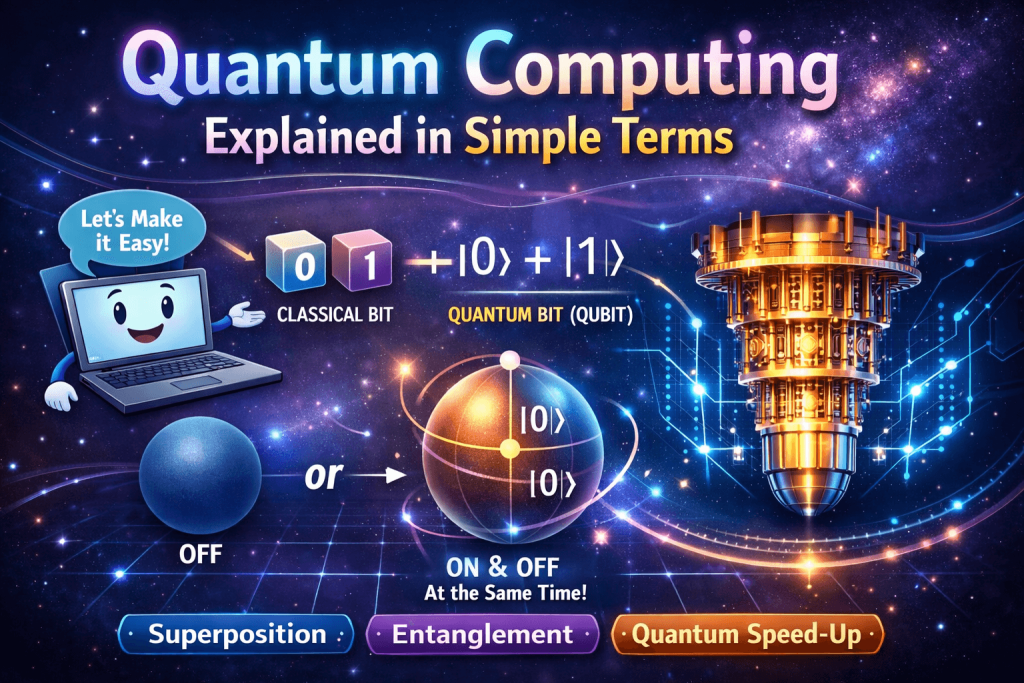
The term “quantum computing” is everywhere these days. From tech headlines to boardroom discussions, everyone’s talking about it. But what exactly is quantum computing? More importantly, should you care about it as a business owner or a regular person going about their daily life?
Let me break it down for you in simple terms.
What is Quantum Computing, Really?
Think of your current computer or smartphone. It processes information using bits—tiny switches that are either ON (1) or OFF (0). Everything from your WhatsApp messages to your company’s accounting software runs on these simple 1s and 0s.
Quantum computers are different. They use something called “qubits” (quantum bits). Here’s the mind-bending part: a qubit can be 1, 0, or both at the same time. This is called superposition.
A Simple Analogy
Imagine you’re trying to find the exit in a massive maze:
- Classical computer: Tries one path at a time. If it’s wrong, it backs up and tries another.
- Quantum computer: Explores all possible paths simultaneously.
That’s why quantum computers can solve certain problems millions of times faster than traditional computers.
How Does Quantum Computing Actually Work?
Without getting too technical, quantum computing relies on three key principles from quantum physics:
1. Superposition
As mentioned, qubits exist in multiple states simultaneously until they’re measured. It’s like a coin spinning in the air—it’s both heads and tails until it lands.
2. Entanglement
When qubits become “entangled,” the state of one instantly affects the state of another, no matter how far apart they are. Einstein called this “spooky action at a distance.”
3. Interference
Quantum computers amplify correct answers and cancel out incorrect ones, much like tuning a radio to receive a clear signal.
Why Should You Care? Real-World Applications
Here’s where it gets interesting for business owners and everyday people.
Problems Quantum Computers Can Solve
| Area | Traditional Computer | Quantum Computer |
|---|---|---|
| Drug discovery | Years of trial and error | Simulate molecular interactions in days |
| Financial modelling | Limited scenarios | Analyse millions of market scenarios instantly |
| Traffic optimization | Basic route planning | Real-time city-wide traffic flow optimization |
| Cryptography | Strong but breakable | Nearly unbreakable encryption (or can break current encryption) |
| AI and machine learning | Hours to train models | Minutes to train complex models |
How It Will Help in Daily Life
Healthcare: Imagine doctors having access to personalized medicine designed specifically for your genetic makeup. Quantum computers can analyse your DNA and suggest treatments tailored just for you.
Transportation: Your daily commute could become significantly shorter. Quantum algorithms can optimize traffic lights, public transport schedules, and delivery routes across entire cities in real-time.
Banking and Finance: Better fraud detection, faster loan approvals, and more accurate credit scoring. Your bank could process your home loan application in minutes instead of days.
Weather Forecasting: More accurate predictions weeks in advance. Farmers could plan better. You’d know exactly when to plan that weekend trip.
Online Shopping: Hyper-personalized recommendations. Instead of showing you random products, quantum-powered AI would understand your preferences better than you do yourself.
The Threats: What Could Go Wrong?
Every powerful technology comes with risks. Here’s what you should be aware of:
1. The Encryption Problem
This is the big one. Most of our online security—banking, emails, business transactions—relies on encryption that would take classical computers thousands of years to break.
Quantum computers could break this in hours.
Everything you’ve ever sent “securely” over the internet could theoretically be decoded if someone has been storing that encrypted data.
2. Job Displacement
Like every technological revolution, some jobs will disappear:
- Data analysts doing routine analysis
- Financial modellers
- Certain types of research scientists
- Cybersecurity experts using old methods
But new jobs will also be created—quantum programmers, quantum security specialists, quantum algorithm designers.
3. The Inequality Gap
Quantum computers are expensive. Right now, only tech giants like Google, IBM, and governments can afford them. This could create a massive advantage for large corporations over small businesses.
4. AI Becoming Too Powerful
Combine quantum computing with AI, and you get artificial intelligence that’s exponentially more powerful. This raises important questions about control, ethics, and safety.
How to Prepare: Practical Steps for Businesses and Individuals
Don’t panic, but don’t ignore it either. Here’s what you can do right now.
For Business Owners
Start learning about post-quantum cryptography
The good news? Cryptographers have been preparing for this. “Quantum-resistant” encryption algorithms are already being developed. Stay informed about when your software vendors plan to upgrade.
Assess your data security
Make an inventory of your sensitive data. What absolutely cannot be compromised? Start planning migration to quantum-safe encryption for your most critical systems.
Explore quantum computing services
You don’t need to buy a quantum computer. Cloud-based quantum computing services are already available from IBM, Amazon, and Microsoft. Start with small pilot projects:
- Optimize your supply chain
- Improve your customer recommendation engine
- Enhance your fraud detection systems
Invest in training
Send key team members for quantum computing workshops. Even basic awareness will put you ahead of competitors.
Watch specific industries
If you’re in pharmaceuticals, finance, logistics, or cybersecurity, quantum computing will impact you sooner. Stay extra vigilant.
For Individuals
Update your cybersecurity habits
Use two-factor authentication everywhere. Don’t rely solely on passwords. Biometric security is becoming more important.
Stay informed
Follow tech news. When quantum-safe encryption becomes available for consumer apps, switch to it.
Learn the basics
You don’t need a PhD in physics. Just understand the fundamentals. Free courses are available on platforms like Coursera and YouTube.
Think about your career
If you’re in tech, data science, or analytics, start exploring how quantum computing intersects with your field.
Don’t fall for scams
As quantum computing gains attention, expect scams. No, you cannot “invest in quantum coins” or buy “quantum healing devices.”
The Timeline: When Will This Actually Happen?
Here’s the realistic timeline:
- 2024 – 2025: Experimental phase completed. Limited commercial applications launched.
- 2026 – 2030: Early adopters (large companies, governments) are already seeing real benefits. This is happening right now.
- 2030 – 2035: Quantum computing becomes mainstream for businesses. Quantum-safe encryption becomes standard.
- 2035 onwards: Quantum computers affect daily life significantly.
The “quantum threat” to current encryption is probably 5-10 years away. But preparations need to start now.
What We’re Doing at eBizIndia
As a software development company, we’re keeping a close eye on quantum computing developments. While we’re not building quantum computers, we are:
- Staying updated on quantum-safe security practices
- Advising clients on long-term data security strategies
- Preparing for the migration to post-quantum cryptography
- Exploring quantum computing cloud services for optimization problems
Our clients’ data security is paramount. As quantum computing evolves, we’ll evolve with it.
Frequently Asked Questions
Q: Will quantum computers replace my laptop or smartphone?
A: No. Quantum computers are specialized machines for specific problems. Your laptop will still be the best tool for emails, spreadsheets, and watching Netflix.
Q: Is quantum computing the same as artificial intelligence?
A: No. Quantum computing is a type of computing hardware/method. AI is software/algorithms. However, quantum computers can make AI much more powerful.
Q: Can I buy a quantum computer?
A: Not practically. They cost millions of dollars and require extreme cooling (near absolute zero temperature). You can access quantum computing power through cloud services, though.
Q: Will quantum computers hack my bank account tomorrow?
A: No. We’re still years away from quantum computers being powerful enough to break current encryption at scale. But banks are already preparing for that future.
Q: Should small businesses worry about quantum computing now?
A: Not urgently, but awareness is important. If you handle sensitive customer data or depend heavily on encryption, start conversations with your IT team or vendors about migration plans.
Q: What programming languages are used for quantum computing?
A: Qiskit (Python), Q# (Microsoft), Cirq (Google), and others. Most have Python interfaces, so if your team knows Python, the learning curve isn’t impossibly steep.
Q: Is India working on quantum computing?
A: Yes! The Indian government has launched the National Mission on Quantum Technologies with a ₹8,000 crore budget. IITs and research institutions are actively working on quantum research.
The Bottom Line
Quantum computing isn’t science fiction anymore. It’s real, it’s coming, and it will change how we work and live.
But it’s not something to fear. It’s something to understand and prepare for.
As a business owner, start having conversations about quantum-safe security. As an individual, stay informed and update your digital security practices.
The quantum revolution won’t happen overnight. But those who prepare today will be the ones who thrive tomorrow.
What’s your biggest question or concern about quantum computing? I’d love to hear your thoughts in the comments below.
Arun is the founder and CEO of eBizIndia, a Kolkata-based software development company with 19+ years of experience in building custom business solutions. When he’s not coding or managing client projects, he’s exploring emerging technologies and their impact on Indian businesses.